Abstract. Envelope Detection (ED) is traditionally always used with Fast Fourier Transform (FFT) to identify the rolling element bearing faults. The inability of FFT to detect non-stationary signals makes Wavelet Analysis (WA) an alternative for machinery fault diagnosis as WA can detect both stationary and non-stationery signals. A comparative study of ED with FFT and WA techniques for bearing fault diagnosis is presented in this report and it is shown with help of experimental results that the WA is a better fault diagnostic tool.
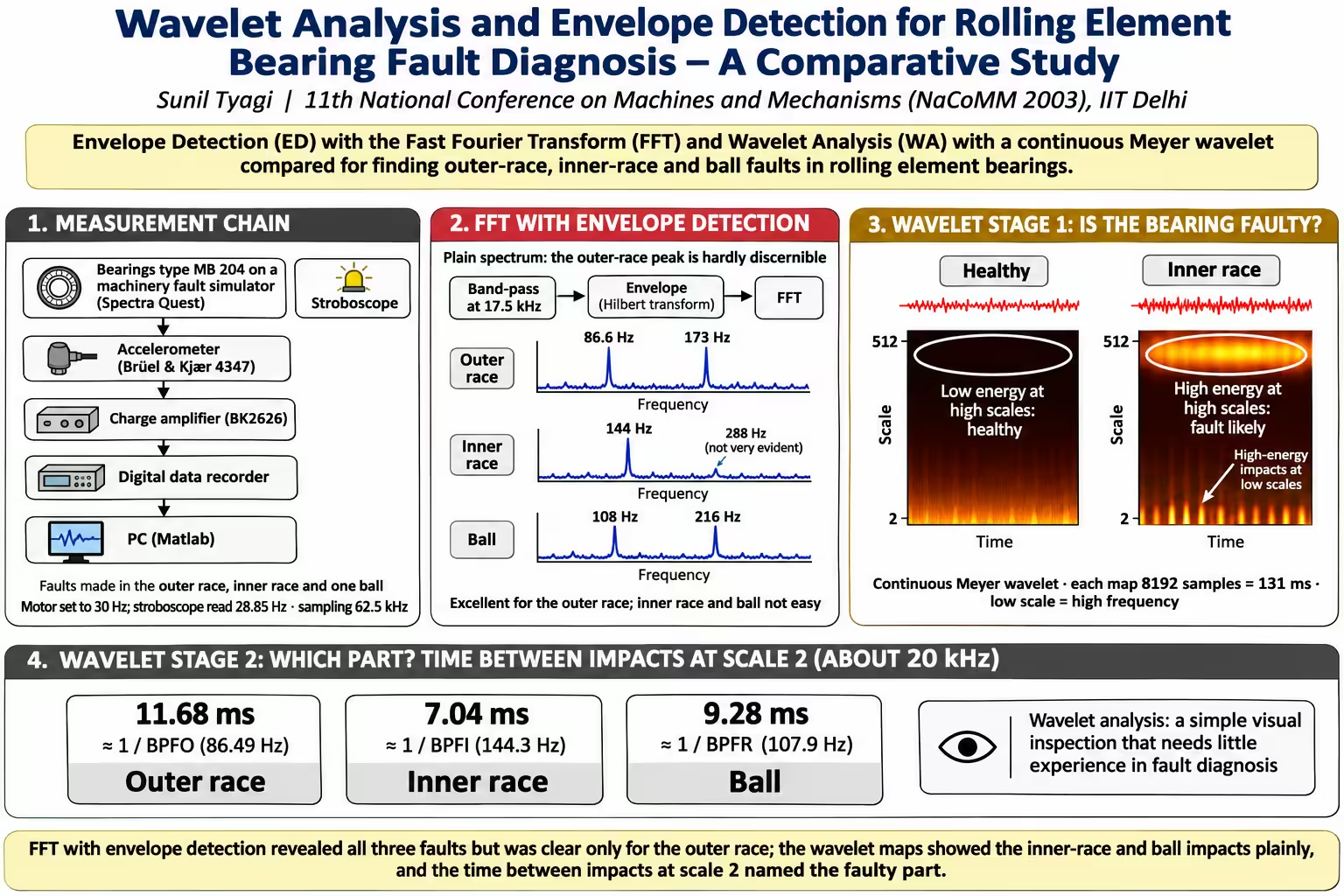
Envelope detection and wavelet analysis, 2003, in plain words
A ball rolling over a bearing defect gives a brief knock, and the knocks carry so little energy that their repetition rate barely shows in an ordinary spectrum: for the outer-race fault tested here, the peak was "hardly discernible". Envelope detection recovers it from the high-frequency ringing the knocks excite. Demodulated after a 17.5 kHz band-pass, the signals gave lines at 86.6 and 173 Hz (outer race), 144 Hz (inner race) and 108 and 216 Hz (ball), so the paper says the ball defect "can also be identified"; it called the method excellent only for the outer race. The wavelet maps add time. Read in two stages, a bright band at high scales hints at a fault, high-energy impacts at low scales confirm it, and the spacing of those impacts is matched against Table 1 to name the damaged part.
Key facts of the 2003 wavelet and envelope study
| Author | Sole author, at the Center of Marine Engineering Technology, INS Shivaji, Lonavla |
|---|---|
| Machine and instruments | Spectra Quest Machinery Fault Simulator, its AC motor on a variable-speed drive turning a shaft rotor assembly carried by two ball bearings; Brüel & Kjær 4347 piezoelectric accelerometer, BK2626 charge amplifier, stroboscope and nSoft digital data recorder |
| Test bearings | Type MB 204, faults artificially induced to give a defective outer race, inner race and ball |
| Speed and sampling | The motor's 30 Hz setting gave a true shaft speed of 28.85 Hz; radial vibration recorded at 62.5 kHz, one sample every 1.6 × 10⁻⁵ s |
| Calculated defect frequencies | 86.49 Hz outer race (BPFO), 144.3 Hz inner race (BPFI), 107.9 Hz ball (BPFR): 723, 433 and 579 samples apart |
| Envelope detection | Matlab code using the Hilbert transform; the filter tried at each resonance visible in the plain spectrum, the 17.5 kHz one working best |
| What the envelope spectra showed | Clear lines at 86.6 and 173 Hz (outer race); 144 Hz, with 288 Hz faint (inner race); 108 and 216 Hz (ball) |
| Wavelet maps | Matlab's continuous wavelet GUI tool with the Meyer wavelet; each map a 131 ms stretch of 8192 samples over scales 2 to 512; the healthy map dark from 128 to 512, the outer-race map bright there, the inner-race and ball maps marked by impacts near the bottom |
| Impact spacing | Read at scale 2, near 20 kHz: 11.68 ms outer race, 7.04 ms inner race, 9.28 ms ball, close to the inverse of each defect frequency |
Where the 2003 NaCoMM paper fits
This was Sunil Tyagi's first paper on bearing diagnostics, from his time at INS Shivaji. The same experiment, with its figures and Table 1, reappears in the 2017 CWT bearing paper, written with S. K. Panigrahi at the Defence Institute of Advanced Technology. The 2008 SVM and ANN bearing paper turned to classifiers, and envelope detection came back, tuned by particle swarm optimisation, in the PSO envelope-detection paper. The Zenodo deposit of November 2026 gave this paper its DOI.
How to cite the 2003 NaCoMM paper
Tyagi S. Wavelet analysis and envelope detection for rolling element bearing fault diagnosis — a comparative study. In: Proceedings of the 11th National Conference on Machines and Mechanisms (NaCoMM 2003), IIT Delhi, 18–19 December 2003. pp. 344–353. doi:10.5281/zenodo.24140108
@inproceedings{tyagi2003nacomm,
  author    = {Tyagi, Sunil},
  title     = {Wavelet Analysis and Envelope Detection for Rolling Element Bearing Fault Diagnosis -- A Comparative Study},
  booktitle = {Proceedings of the 11th National Conference on Machines and Mechanisms (NaCoMM 2003)},
  address   = {IIT Delhi, India},
  year      = {2003},
  month     = dec,
  pages     = {344--353},
  doi       = {10.5281/zenodo.24140108}
}