Abstract. Envelope Detection (ED) is traditionally used to identify the rolling element bearing faults. ED involves carrying considerable signal processing. In past few years Wavelet Analysis (WA) has been widely used an alternative tool for detection of machinery fault diagnosis as WA is able to provide multi-resolution analysis and give both frequency and time information suitable to analyse non-stationery signals such as vibration signal from bearing. This paper presents a very simple Wavelet analysis technique using Continuous Wavelet Transform (CWT) that does not require complex signal processing. A comparative study of effectiveness of ED and CWT method for bearing fault diagnosis is presented in this paper and it is shown with help of experimental results that the proposed simple CWT based method is better fault diagnostic tool for bearing fault identification.
The CWT bearing-fault method in plain words
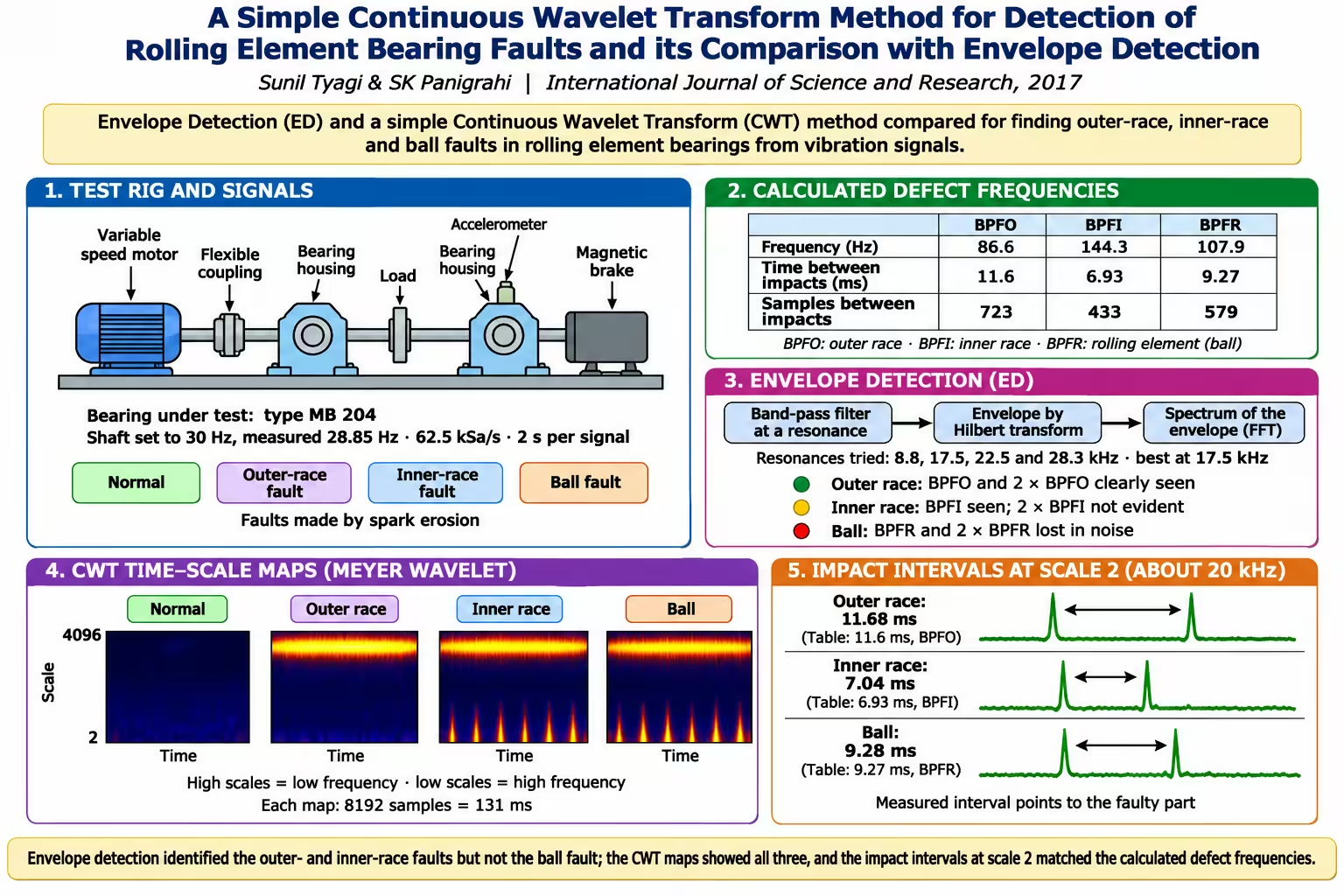
Each time a ball passes a bearing defect it strikes it, but each impact spreads its energy thinly over a wide band, so the defect frequency hides in a plain spectrum. Envelope detection, the traditional remedy, band-passes the signal round a structural resonance and takes the spectrum of its envelope. This paper sets beside it a simpler method: look at continuous wavelet maps of the signal, then measure the time between impacts at a single scale. With the shaft at 28.85 Hz, Table 1 gives defect frequencies of 86.6 Hz for the outer race, 144.3 Hz for the inner race and 107.9 Hz for the ball. Envelope detection showed the outer-race fault clearly and the inner-race fault less clearly; for the ball, the paper finds the fault cannot be identified. At scale 2 the impacts were 11.68, 7.04 and 9.28 ms apart, against Table 1's 11.6, 6.93 and 9.27 ms.
Key facts of the CWT and envelope detection study
| Bearing and faults | Ball bearings type MB 204 on a shaft–rotor assembly driven by a variable-speed AC motor; one healthy bearing and three with a fault made by spark erosion, in the outer race, the inner race or a ball |
|---|---|
| Recording | Shaft set to 30 Hz, 28.85 Hz by stroboscope; accelerometer stud-mounted on the bearing housing; 62.5 kSa/s, 2 s per signal |
| Defect frequencies (Table 1) | BPFO 86.6 Hz, BPFI 144.3 Hz, BPFR 107.9 Hz; 11.6, 6.93 and 9.27 ms between impacts |
| Envelope detection | Band-pass round a resonance, envelope by the Hilbert transform, spectrum of the envelope; resonances at 8.8, 17.5, 22.5 and 28.3 kHz tried; best at 17.5 kHz |
| Envelope detection results | Outer race: BPFO and its second harmonic (173 Hz) clearly seen. Inner race: BPFI (144 Hz) seen, its second harmonic (288 Hz) not very evident. Ball: BPFR (108 Hz) and 216 Hz submerged in noise; the paper finds the fault cannot be identified |
| Wavelet | Continuous Meyer wavelet, in Matlab |
| CWT maps | 8192 samples (131 ms) per map, scales 2 to 4096; the healthy bearing dark at scales 256 to 4096; the outer-race fault bright at high scales; the inner-race and ball faults with bright strips at regular intervals at low scales |
| Intervals at scale 2 (about 20 kHz) | Outer race 11.68 ms, inner race 7.04 ms, ball 9.28 ms, as printed in Fig. 14 |
| Conclusion | Both methods find the outer-race fault; the CWT maps show all three, read by eye in two stages: high energy at high scales points to a fault, the interval at scale 2 to the faulty part |
Where the CWT bearing paper fits
This is one of the 2014–2017 papers from PhD research at the Defence Institute of Advanced Technology, Pune. The experiment, its figures and Table 1 first appeared in Sunil Tyagi's 2003 NaCoMM paper; this 2017 journal version was written with S. K. Panigrahi. Envelope detection returns in the PSO envelope-detection paper, where particle swarm optimisation chooses the band. The other papers from the research are listed under journal papers.
How to cite the CWT bearing paper
Tyagi S, Panigrahi SK. A simple continuous wavelet transform method for detection of rolling element bearing faults and its comparison with envelope detection. International Journal of Science and Research. 2017;6(3):1033–1040. doi:10.21275/ART20171614
@article{tyagi2017cwt,
  author  = {Tyagi, Sunil and Panigrahi, S. K.},
  title   = {A Simple Continuous Wavelet Transform Method for Detection of Rolling Element Bearing Faults and its Comparison with Envelope Detection},
  journal = {International Journal of Science and Research},
  year    = {2017},
  volume  = {6},
  number  = {3},
  pages   = {1033--1040},
  doi     = {10.21275/ART20171614}
}