Abstract. Traditionally Envelope Detection (ED) is implemented for detection of rolling element bearing faults by extracting the envelope of band-passed vibration signal and thereafter taking its Fourier transform. The performance of ED is highly sensitive to the envelope window (i.e. central frequency and bandwidth of the passband). This paper employs Particle Swarm Optimisation (PSO) to select the most optimum envelope window to band pass the vibration signals emanating from rotating driveline that was run in normal and with faults induced rolling element bearings. The envelopes of band-passed signals were extracted with the help of Hilbert Transform. The performance of ED whose envelope window was optimised by PSO to identify various commonly occurring bearing faults such as bearing with Outer Race Fault (ORF), Inner Race Fault (IRF) and Rolling Element Fault (REF) were checked under varying load conditions. The performance of ‘ED enhanced by PSO’ was also checked with increase in the severity of defect. It was shown that the improved ED method is successfully able to identify all types of bearing faults under different load conditions. It was shown that the by selecting envelope window by PSO makes ED especially useful to identify bearing faults at the incipient stage of defect. It was also shown by presenting comparative performance that by optimising the envelope window by PSO the performance of ED gets significantly enhanced in comparison to the traditional ED method for bearing fault diagnosis.
PSO-tuned envelope detection in plain words
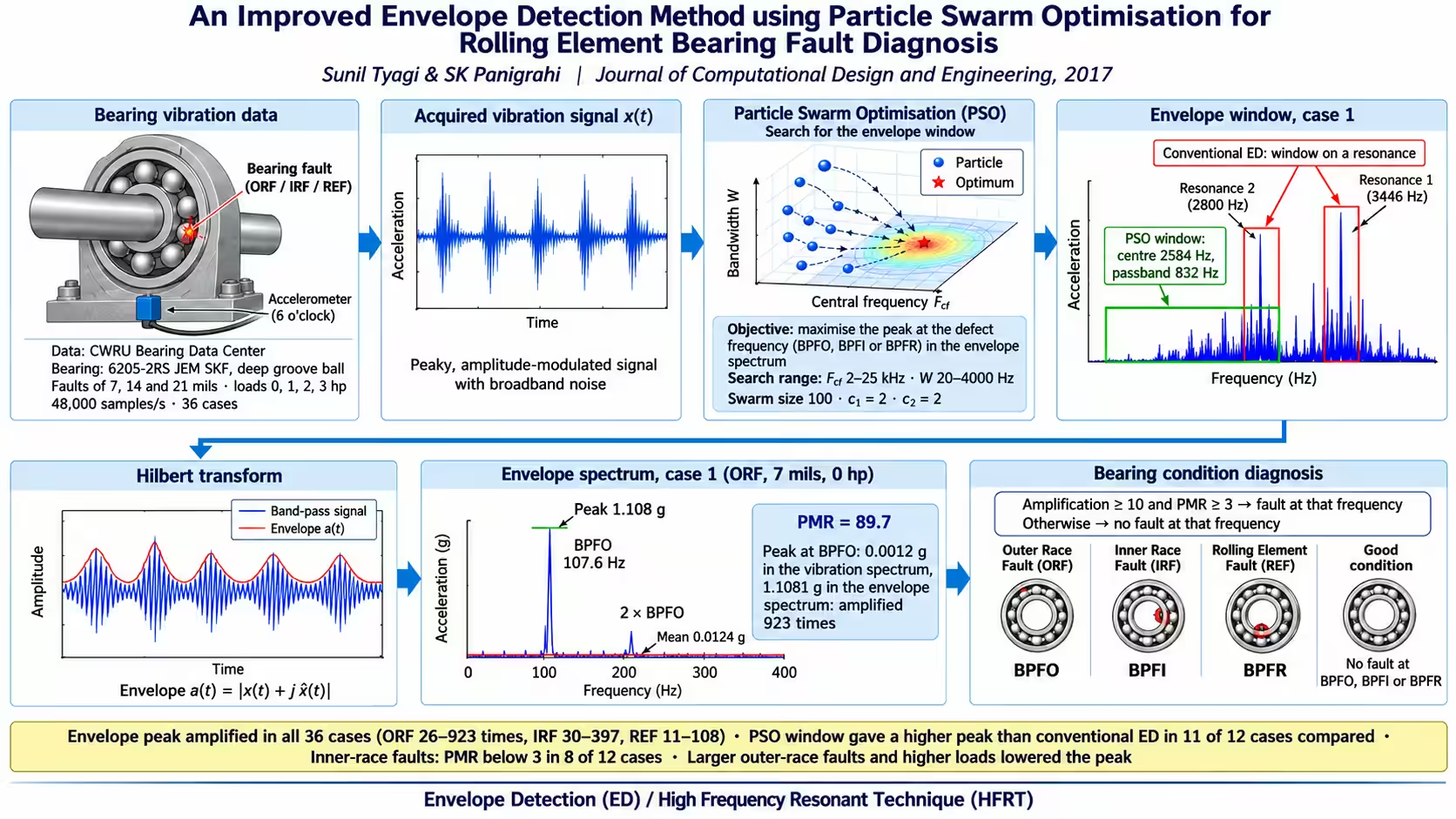
Each time a ball passes a small bearing defect, the impact rings the bearing's resonances, and the defect frequency hides in the plain spectrum. Envelope detection band-passes the signal around a resonance and takes the spectrum of its envelope, so it works only as well as that band, the envelope window, is chosen. Here particle swarm optimisation (PSO) searches the window's centre and width for the tallest defect-frequency peak. The recordings come from the Case Western Reserve University (CWRU) Bearing Data Center, not from the authors' own rig. In case 1 (outer race, no load), PSO centred the window at 2584 Hz, 832 Hz wide, beside resonances at 2800 and 3446 Hz; the defect-frequency peak stood 923 times higher than in the plain spectrum, and 89.7 times the envelope spectrum's mean level, its peak-to-mean ratio (PMR). Amplification ran from 11 to 923 over all 36 cases, but in 8 of the 12 inner-race cases the PMR stayed below 3, which the paper notes could have passed for a good bearing.
Key facts of the PSO envelope-detection study
| Data | Recorded by others, at the Case Western Reserve University (CWRU) Bearing Data Center; the paper thanks Prof. K. A. Loparo |
|---|---|
| Bearing | SKF 6205-2RS JEM deep groove ball bearing, motor drive end |
| Faults | One per bearing: outer race, inner race or rolling element; 7, 14 or 21 mils across, by spark erosion |
| Loads and speeds | 0, 1, 2 and 3 hp; 1797 to 1730 rpm; 36 cases |
| Recording | Acceleration, 5 s at 48,000 samples per second |
| Method | Band-pass, Hilbert envelope, envelope spectrum; PSO picks the band that maximises the peak at BPFO, BPFI or BPFR |
| PSO settings | Centre 2000 to 25000 Hz; bandwidth 20 to 4000 Hz; c1 = c2 = 2; inertia 0.99 to 0.4; swarm of 100 |
| Against the conventional window | A higher peak in 11 of the 12 cases compared |
| Decision rule | Fault if amplification is at least 10 and PMR at least 3; good if no fault type passes |
| Amplification | Outer race 26 to 923, inner race 30 to 397, rolling element 11 to 108 |
| PMR | Outer race 5 to 200; inner race below 5, and below 3 in 8 of 12 cases |
| Good bearing | Amplification generally below 10, PMR below 3, with a few exceptions; no check in Table 4 met both thresholds |
| Fault size and load | Larger outer-race faults gave a lower peak, larger inner-race and rolling-element faults a higher one; more load, a lower peak |
Where the PSO envelope-detection paper fits
This is one of the 2014–2017 papers from PhD research at the Defence Institute of Advanced Technology, Pune, and the one of them built on a public data set. Envelope detection was already the subject of Sunil Tyagi's 2003 NaCoMM paper, "Wavelet analysis and envelope detection for rolling element bearing fault diagnosis — a comparative study", and of the 2017 paper "A simple continuous wavelet transform method for detection of rolling element bearing faults and its comparison with envelope detection" (both in publications). The same three steps underlie the vessel-noise analysis of the DEMON working note.
How to cite the PSO envelope-detection paper
Tyagi S, Panigrahi SK. An improved envelope detection method using particle swarm optimisation for rolling element bearing fault diagnosis. Journal of Computational Design and Engineering. 2017;4(4):305–317. doi:10.1016/j.jcde.2017.05.002
@article{tyagi2017psoed,
  author  = {Tyagi, Sunil and Panigrahi, S. K.},
  title   = {An improved envelope detection method using particle swarm optimisation for rolling element bearing fault diagnosis},
  journal = {Journal of Computational Design and Engineering},
  year    = {2017},
  volume  = {4},
  number  = {4},
  pages   = {305--317},
  doi     = {10.1016/j.jcde.2017.05.002}
}