Abstract. Effectiveness of transient analysis of the finite element bearing model to simulate the vibration signal emanating from ball bearing with faults is presented in this work. It is difficult to identify the ball bearing defect either in frequency spectrum or time domain when the defect is at incipient stage. Further, it is difficult to experimentally obtain vibration signals from bearing having fault at incipient stage. Thus, need for accurate simulation of ball bearing fault at incipient stage is considered essential. A Computer Aided Design (CAD) model of a ball bearing having a minor crack in outer-race was created using commercially available software. It was shown that identification of ball bearing defect in frequency spectrum is difficult. The results were validated with experimental results.
The bearing fault simulation in plain words
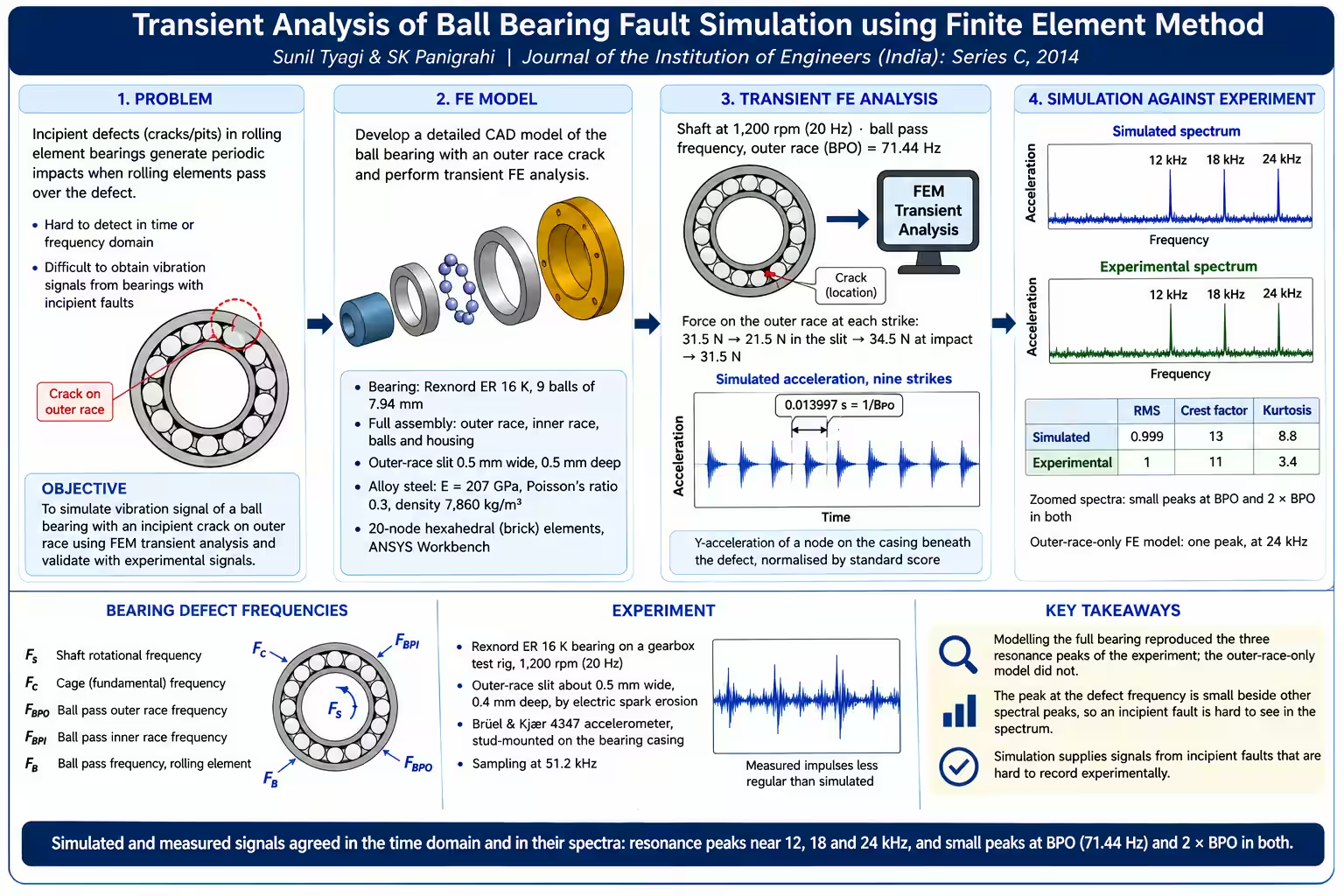
A bearing fault in its early stage is hard to see in a vibration spectrum, and recordings from such a bearing are hard to come by. This paper builds a finite element model of a Rexnord ER 16 K ball bearing with a slit across its outer race, varies the force on the outer race as each ball passes the slit, and compares the simulated vibration with a measured one. With the shaft at 1,200 rpm, the ball pass frequency, outer race (BPO) is 71.44 Hz; nine strikes were simulated. Simulated and measured spectra share resonance peaks near 12, 18 and 24 kHz, and in both the peak at BPO is small beside other peaks. RMS, crest factor and kurtosis were 0.999, 13 and 8.8 simulated, and 1, 11 and 3.4 measured. A model of the outer race alone gave a single peak, at 24 kHz. The measured impulses were less regular than the simulated ones.
Key facts of the bearing fault simulation
| Bearing | Rexnord ER 16 K ball bearing: outer diameter 52.00 mm, bore 25.40 mm, raceway width 19.05 mm; nine balls of 7.94 mm; contact angle 0° |
|---|---|
| Defect | A slit 0.5 mm wide and 0.5 mm deep across the outer raceway |
| FE models | The outer race alone, with a finer mesh round the defect; and the full assembly of outer race, inner race, balls and housing |
| Elements and material | 20-node hexahedral elements; isotropic alloy steel, E = 207 GPa, Poisson's ratio 0.3, density 7,860 kg/m³ |
| Boundary conditions | Outer race stationary, defect at the bottom; frictional contact with the casing, fixed at its studs; frictionless contact between balls and races |
| Loading | 1,200 rpm (20 Hz); one strike every 1.399 × 10⁻² s; force on the outer race 31.5 N, 21.5 N in the slit, 34.5 N at impact, then 31.5 N |
| Output | Y-acceleration of a node on the casing beneath the defect, in ANSYS Workbench; nine strikes, normalised by standard score |
| Experiment | Gearbox test rig at 1,200 rpm; outer-race fault about 0.5 mm wide and 0.4 mm deep, by electric spark erosion; Brüel & Kjær 4347 accelerometer at the drive-end bearing; sampling at 51.2 kHz |
| Agreement | Peaks near 12, 18 and 24 kHz in both spectra; small peaks at BPO and 2 × BPO in both zoomed spectra; RMS, crest factor and kurtosis compared in Table 2 |
| Outer-race-only model | One peak, at 24 kHz, against three above 10 kHz in the experiment; the full model came closer |
Where the bearing fault simulation paper fits
Published in 2014 with S. K. Panigrahi, this is the earliest of the 2014–2017 papers from PhD research at the Defence Institute of Advanced Technology, Pune. It is a revised and expanded version of an article presented at a national conference at the North East Regional Institute of Science and Technology, Arunachal Pradesh, in November 2013. The later bearing papers turned from simulating a fault's vibration to detecting it: the PSO envelope-detection paper, the DWT and SVM bearing paper and the continuous wavelet transform paper.
How to cite the bearing fault simulation paper
Tyagi S, Panigrahi SK. Transient analysis of ball bearing fault simulation using finite element method. Journal of the Institution of Engineers (India): Series C. 2014;95(4):309–318. doi:10.1007/s40032-014-0129-x
@article{tyagi2014fem,
  author  = {Tyagi, Sunil and Panigrahi, S. K.},
  title   = {Transient Analysis of Ball Bearing Fault Simulation using Finite Element Method},
  journal = {Journal of the Institution of Engineers (India): Series C},
  year    = {2014},
  volume  = {95},
  number  = {4},
  pages   = {309--318},
  doi     = {10.1007/s40032-014-0129-x}
}