Abstract. A classification technique using Support Vector Machine (SVM) classifier for detection of rolling element bearing fault is presented here. The SVM was fed from features that were extracted from of vibration signals obtained from experimental setup consisting of rotating driveline that was mounted on rolling element bearings which were run in normal and with artificially faults induced conditions. The time-domain vibration signals were divided into 40 segments and simple features such as peaks in time domain and spectrum along with statistical features such as standard deviation, skewness, kurtosis etc. were extracted. Effectiveness of SVM classifier was compared with the performance of Artificial Neural Network (ANN) classifier and it was found that the performance of SVM classifier is superior to that of ANN. The effect of pre-processing of the vibration signal by Discreet Wavelet Transform (DWT) prior to feature extraction is also studied and it is shown that pre-processing of vibration signal with DWT enhances the effectiveness of both ANN and SVM classifiers. It has been demonstrated from experiment results that performance of SVM classifier is better than ANN in detection of bearing condition and pre-processing the vibration signal with DWT improves the performance of SVM classifier.
The DWT and SVM bearing-fault method in plain words
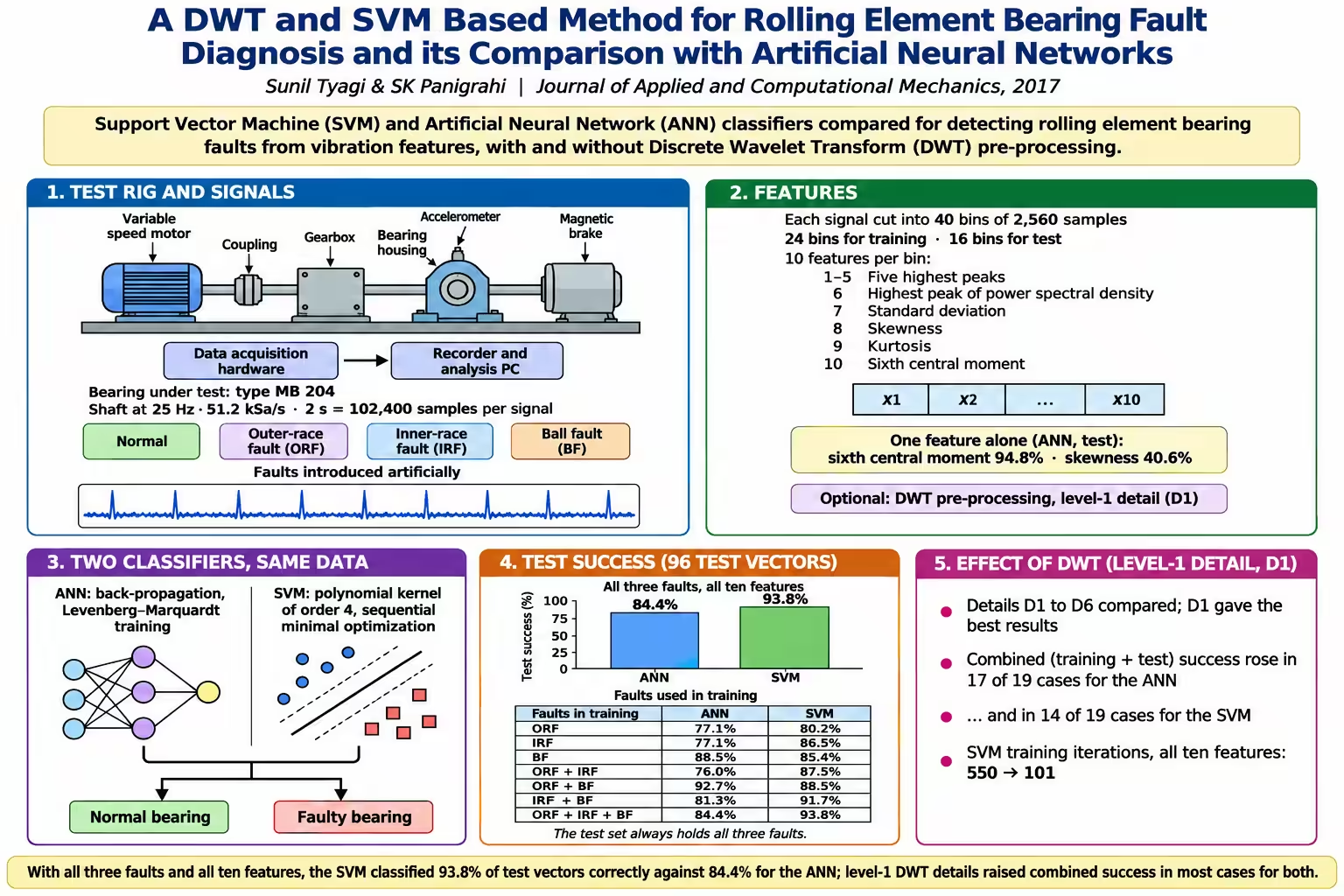
Each time a ball passes a defect, the bearing takes a short impact whose energy spreads over many frequencies, so the defect frequency is easily lost in noise. This paper trains a support vector machine (SVM) and an artificial neural network (ANN) to tell a faulty bearing from a good one from ten simple features of the vibration signal: its five highest peaks, the highest peak of its power spectral density, standard deviation, skewness, kurtosis and sixth central moment. Trained on all three fault types with all ten features, the SVM classified 90 of 96 test vectors correctly (93.8%), the ANN 81 (84.4%). Trained on one fault type at a time, both still scored 77.1% to 88.5% on test vectors holding all three. Features taken from the level-1 detail of a discrete wavelet transform (DWT) raised combined training and test success in 17 of 19 cases for the ANN and 14 of 19 for the SVM.
Key facts of the DWT and SVM bearing study
| Test rig | Variable-speed AC motor driving a shaft and rotor on two ball bearings through flexible couplers; load from a belt-driven magnetic brake |
|---|---|
| Bearing and faults | Type MB 204, at the load end; normal, outer-race fault, inner-race fault and ball fault, the faults made artificially |
| Recording | Accelerometer stud-mounted on the bearing housing; shaft at 25 Hz; 2 s at 51.2 kSa/s, 102,400 samples per signal |
| Features | Each signal cut into 40 bins of 2,560 samples; ten features per bin |
| Training and test | 24 bins of each signal for training, 16 for test; 144 training and 96 test vectors, half from a faulty bearing and half from the normal one |
| The 19 cases | Cases 1–7 vary the fault types used in training; cases 8–19 vary the features; every case is tested on the same 96 vectors |
| Classifiers | ANN trained by back-propagation (Levenberg–Marquardt); SVM with a fourth-order polynomial kernel and sequential minimal optimisation |
| Best result | All three faults and all ten features (case 7): SVM 90 of 96 test vectors (93.8%), ANN 81 (84.4%) |
| DWT | Daubechies wavelet, six levels; the level-1 detail (D1) did best, with SVM training success of 94.3% and test success of 80% over all 19 cases |
| Training iterations | Case 7 with D1 instead of the raw signal: SVM 550 to 101, ANN 32 to 27 |
Where the DWT and SVM bearing paper fits
This 2017 journal version, written with S. K. Panigrahi, is one of the 2014–2017 papers from PhD research at the Defence Institute of Advanced Technology, Pune. The experiment and its result tables first appeared in Sunil Tyagi's 2008 paper in the International Journal of Mechanical and Mechatronics Engineering. The 2017 continuous wavelet transform paper used the same rig and MB 204 bearing, with its own recordings at 30 Hz. The SVM–ANN gear-fault paper says its rig and features follow this one.
How to cite the DWT and SVM bearing paper
Tyagi S, Panigrahi SK. A DWT and SVM based method for rolling element bearing fault diagnosis and its comparison with artificial neural networks. Journal of Applied and Computational Mechanics. 2017;3(1):80–91. doi:10.22055/jacm.2017.21576.1108
@article{tyagi2017dwtsvm,
  author  = {Tyagi, Sunil and Panigrahi, S. K.},
  title   = {A {DWT} and {SVM} based method for rolling element bearing fault diagnosis and its comparison with {Artificial Neural Networks}},
  journal = {Journal of Applied and Computational Mechanics},
  year    = {2017},
  volume  = {3},
  number  = {1},
  pages   = {80--91},
  doi     = {10.22055/jacm.2017.21576.1108}
}