What the quantum warfare chapter covers
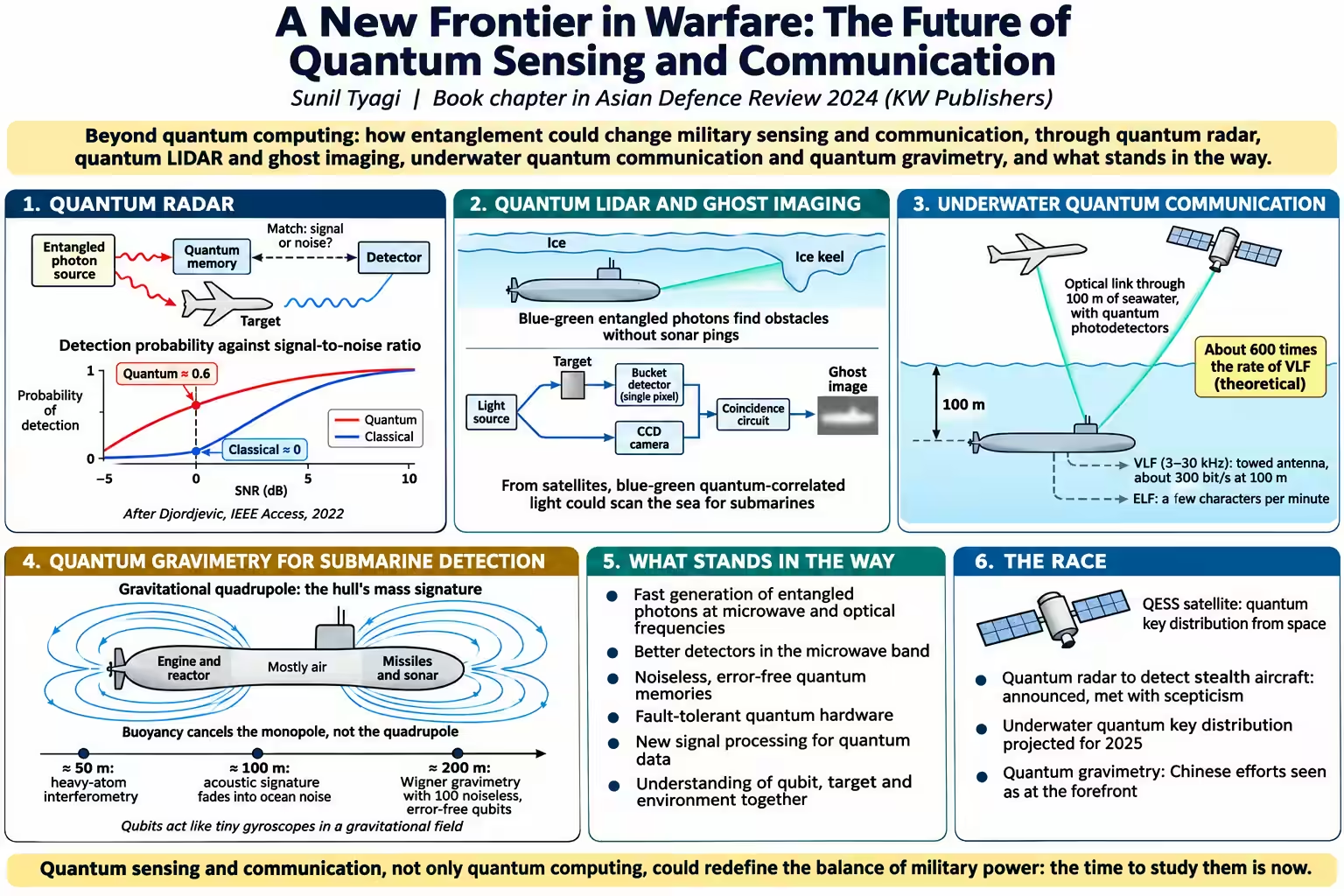
This chapter, by Sunil Tyagi, looks past quantum computing and quantum cryptography to what entanglement could do for military sensing and communication. In a quantum radar, one photon of an entangled pair is held in a quantum memory while its twin goes out to the target, and matching the two helps tell a faint return from noise. A figure the chapter takes from Djordjevic (IEEE Access, 2022) shows the gain: at a signal-to-noise ratio of 0 dB, a detection probability of 0.6 for the quantum radar against almost none for a classical one, with the advantage lying between −5 and 10 dB. Quantum LIDAR could let a submarine find ice without sonar pings, and ghost imaging with blue-green light from satellites could search the sea for submarines. Under water, an optical link through 100 m of seawater could in theory carry about 600 times as much as VLF radio, which manages about 300 bits per second at that depth. Quantum gravimetry could sense a submarine’s gravitational quadrupole: at about 50 m by heavy-atom interferometry, and at about 200 m with 100 noiseless, error-free qubits. The chapter ends with the challenges that remain and with China’s programme.
Key points of the quantum warfare chapter
| The argument | Codebreaking and the atomic bomb changed the Second World War; quantum information science could change warfare as much, through sensing and communication as well as computing |
|---|---|
| Three areas | Standoff electromagnetic quantum sensing, underwater quantum communication and quantum gravimetry |
| Quantum radar | The returning photon is matched against its entangled twin in quantum memory; the gain is largest at low signal-to-noise ratios |
| Quantum LIDAR and ghost imaging | Blue-green entangled photons to find obstacles under ice without sonar; a bucket detector, a CCD camera and a coincidence circuit build an image of a target the camera never sees |
| Underwater communication | VLF needs a towed antenna and gives about 300 bits per second at 100 m, ELF a few characters per minute; an optical link with quantum photodetectors could give about 600 times VLF’s rate in theory |
| Quantum gravimetry | A nuclear submarine, heavy at both ends and light in the middle, has a gravitational quadrupole that buoyancy does not cancel; its acoustic signature fades beyond about 100 m, but Wigner gravimetry might reach about 200 m |
| What stands in the way | Fast generation of entangled photons, better microwave detectors, noiseless quantum memories, fault-tolerant hardware, new signal processing |
| China’s programme | The QESS satellite and quantum key distribution; translations of US Naval Research Laboratory work from 2011 and 2017; a quantum radar against stealth aircraft, met with scepticism; underwater quantum key distribution projected for 2025 |
Where the quantum warfare chapter fits
The chapter appears in Asian Defence Review 2024, edited by Anil Golani and published by KW Publishers, New Delhi, a volume on emerging technologies and the changing threats India faces. The PDF here is the author’s manuscript, so its pages do not match the book’s: please cite the published chapter, pp. 30–57. Sunil Tyagi’s other 2024 chapter is Indian AI Military Innovation, and his open edition of a quantum computing book, The Beginner’s Guide to Quantum Computing, is listed with his books.
How to cite the quantum warfare chapter
Tyagi S. A new frontier in warfare: the future of quantum sensing and communication. In: Golani A, editor. Asian Defence Review 2024: Emerging Technologies and Changing Dimensions of Threats for India. New Delhi: KW Publishers; 2024. p. 30–57.
@incollection{tyagi2024frontier,
  author    = {Tyagi, Sunil},
  title     = {A New Frontier in Warfare: The Future of Quantum Sensing and Communication},
  booktitle = {Asian Defence Review 2024: Emerging Technologies and Changing Dimensions of Threats for India},
  editor    = {Golani, Anil},
  publisher = {KW Publishers},
  address   = {New Delhi},
  year      = {2024},
  pages     = {30--57},
  isbn      = {978-81-973214-3-6}
}