What the Indian AI military innovation chapter covers
This chapter, by Sunil Tyagi and Anil Golani, is chapter 4 of Global AI Military Innovation and Future of Warfare, NAFI Research Report 24-12, edited by Jungmi Cha and published by the National Assembly Futures Institute (NAFI) in 2024. It asks how India is preparing its armed forces for wars in which artificial intelligence plays a part, in seven sections. It opens with three lessons India can draw from the war in Ukraine, and five threats to India’s military AI. It then sets out the national strategy and what the services are doing, from decision support and war games to autonomous systems and cyber security, and the structural change this calls for, centred on the Defence Artificial Intelligence Council. A section on governance weighs India’s strengths against ten infrastructure challenges, and looks to public-private collaboration and defence exports. The talent pipeline follows: education, centres of excellence and the upskilling of serving personnel. The chapter ends with India’s stance on keeping a human in the loop over autonomous weapons, and a roadmap that rests on innovation, collaboration, ethics and human oversight.
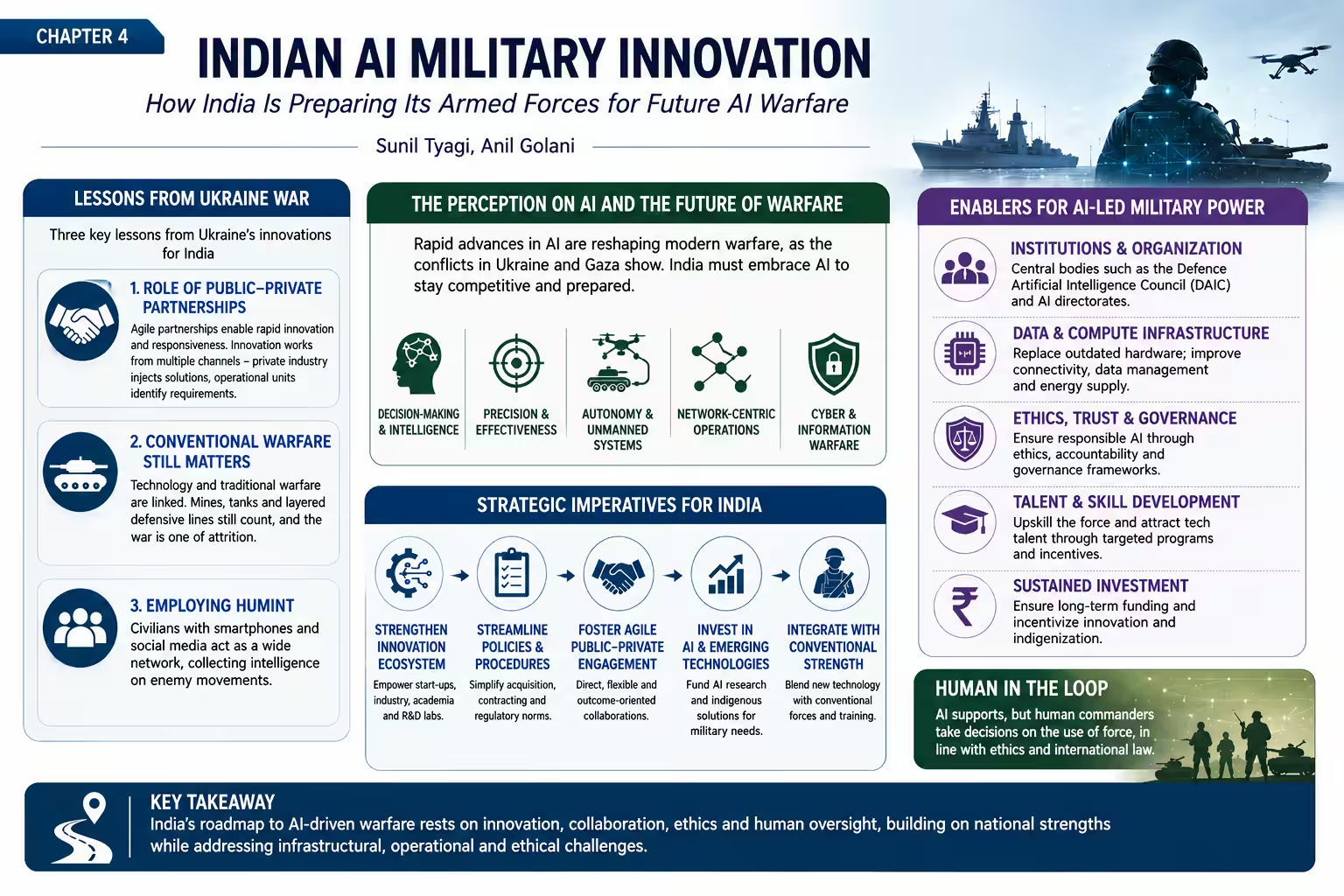
Key points of the chapter
| Section | Report pages | What it says |
|---|---|---|
| AI and the future of warfare | 109–112 | Three lessons from Ukraine: public-private partnerships; conventional warfare still matters; civilians with smartphones as a source of human intelligence. Five threats, from China’s rapid AI advances to data security |
| A national AI strategy | 113–122 | Decision support and intelligence; the Army’s and the Navy’s programmes; AI-based war games (Army Training Command, May 2022); lethal autonomous weapons systems; cyber security; surveillance; autonomous systems in combat |
| Structural and organisational change | 123–126 | Central bodies led by the Defence Artificial Intelligence Council (DAIC); AI-enhanced command and control; cross-domain integration; AI-driven cyber security and information warfare |
| Governance | 127–133 | Six strengths, from a skilled AI workforce to experience in software services; ten infrastructure challenges, from outdated hardware and software to the DRDO’s slow pace of research and development; public-private collaboration; alliances and defence exports |
| Education and talent | 134–139 | AI education and military training; centres of excellence; academia, defence and industry working together; upskilling serving personnel, as at the Air Force’s centre at Rajokri |
| The human in the loop | 140–143 | Guidelines from the Ministry of Defence and the DAIC for human control of autonomous systems; India’s stance at the UN Group of Governmental Experts (Ambassador D. B. Venkatesh Varma, 2014); MQ-9B drones kept under human oversight; machine speed against human decision |
| Conclusion | 143–144 | A roadmap for AI-driven warfare that rests on innovation, collaboration, ethics and human oversight |
Where the chapter sits in the NAFI report
The chapter is the fourth of seven in Part II of the report, “Global Military Powers’ AI Military Innovation”, beside chapters on the United States, Russia, China, the United Kingdom, Israel and NATO. The report was published by the National Assembly Futures Institute, and the full report is available from NAFI. The PDF here holds the chapter, report pages 109–144, followed by the report’s cover and contents. Sunil Tyagi’s other 2024 chapter is A New Frontier in Warfare: The Future of Quantum Sensing and Communication.
How to cite the chapter
Tyagi S, Golani A. Indian AI military innovation. In: Cha J, editor. Global AI Military Innovation and Future of Warfare. NAFI Research Report 24-12. National Assembly Futures Institute; 2024. p. 109–144.
@incollection{tyagi2024nafi,
  author    = {Tyagi, Sunil and Golani, Anil},
  title     = {Indian AI Military Innovation},
  booktitle = {Global AI Military Innovation and Future of Warfare},
  editor    = {Cha, Jungmi},
  series    = {NAFI Research Report},
  number    = {24-12},
  publisher = {National Assembly Futures Institute},
  year      = {2024},
  pages     = {109--144},
  isbn      = {979-11-94650-08-9}
}