Abstract. An Artificial Neural Network (ANN) classifier trained by a hybrid GA-BP method for diagnosis of gear faults is presented here that can be incorporated in an online fault diagnostic system of vital gearboxes. The distinctive features obtained from vibration signals of a running gearbox; that was operated in normal and with faults induced conditions were used to feed the GA-BP hybrid classifier. Time domain vibration signals were divided in 40segments. From each segment features such as magnitude of peaks in time domain and spectrum along with statistical features such as central moments and standard deviations were extracted to feed the classifier. Based on the experimental results it was shown that the GA-BP hybrid classifier can successfully identify gear condition. It was also shown that the network trained by GA-BP hybrid method performs much better than ANN that is trained by standard BP or GA individually. Further, it was also shown that if prior to extraction of features; the vibration signals are pre-processed by Discrete Wavelet Transform (DWT) then efficacy of the GA-BP hybrid is significantly enhanced.
The GA–BP gearbox classifier in plain words
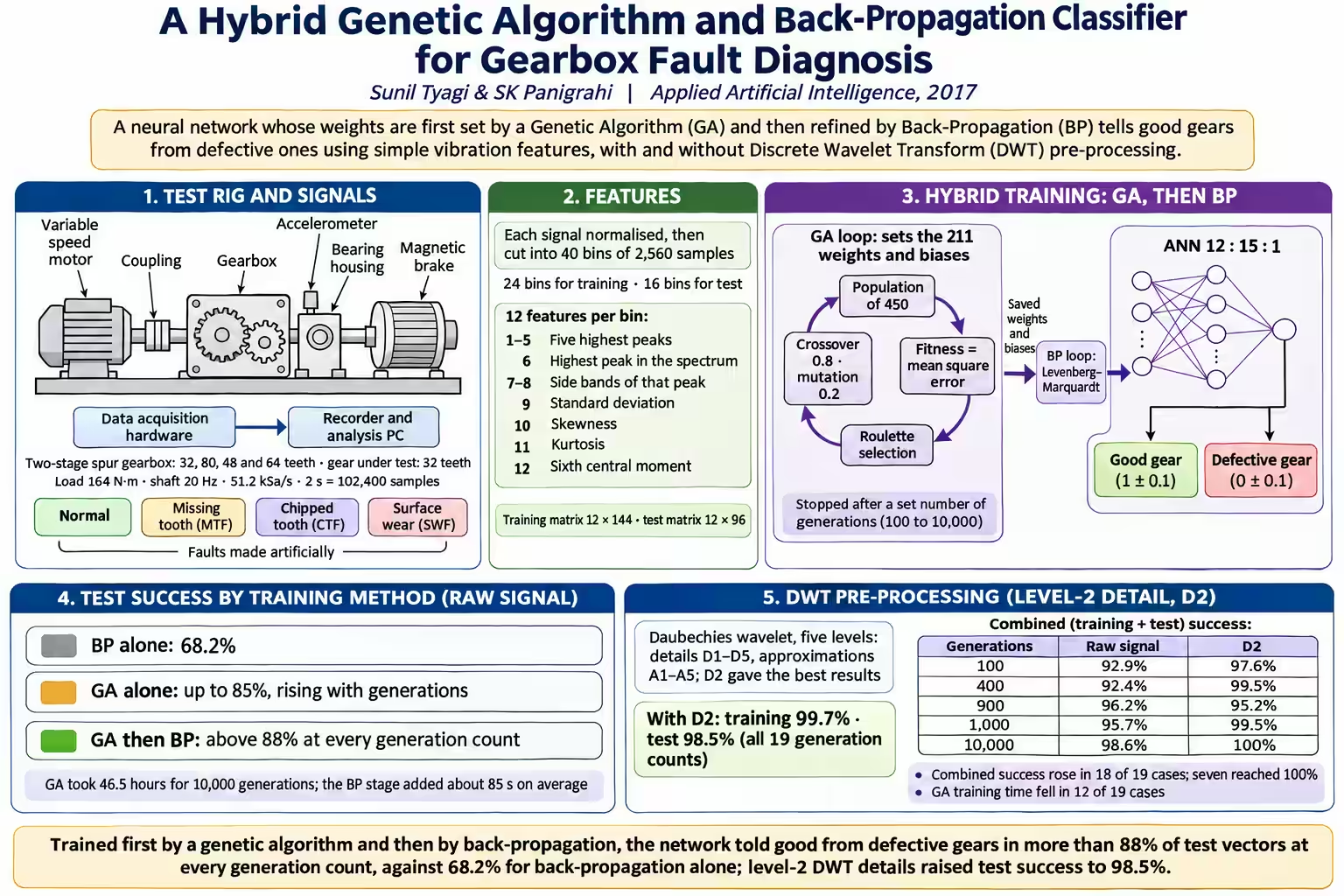
A gear fault changes the way a gearbox vibrates, but among the meshing frequencies and broadband noise of a running gearbox it is hard to see in a plain spectrum. A neural network can learn to tell a good gear from a defective one, yet back-propagation, the usual way of training it, can settle in a local minimum that depends on its random starting weights. This paper lets a genetic algorithm choose the network's weights first and back-propagation finish the training. Trained by back-propagation alone, the network classified 68.2% of the test vectors correctly; trained by the genetic algorithm and then back-propagation, it scored above 88% at every generation count tried. With features taken from the level-2 wavelet details, test success over all 19 cases was 98.5%. The cost is time: 10,000 generations of the genetic algorithm took 46.5 hours, against about 85 s for the back-propagation stage.
Key facts of the GA–BP gearbox study
| Test rig and gear | Variable-speed AC motor and a two-stage parallel-shaft gearbox with spur gears of 32, 80, 48 and 64 teeth; the 32-tooth gear was tested |
|---|---|
| Faults | Missing tooth, chipped tooth and surface wear, made artificially, each compared with a gear in normal condition |
| Recording | Accelerometer on the bearing housing; load 164 N·m, shaft at 20 Hz; 2 s per condition at 51.2 kSa/s, so 102,400 samples |
| Features | 40 bins of 2,560 samples per normalised signal, 24 for training and 16 for test; 12 features per bin from time-domain peaks, the spectrum and its side bands, and central moments |
| Network | One hidden layer, best at 12:15:1; output 1 for a good gear and 0 for a defective one, counted correct only within ±0.1 |
| Genetic algorithm | Fitness the mean square error; 211 weights and biases; population 450; crossover 0.8, mutation 0.2; roulette selection; 100 to 10,000 generations |
| Back-propagation | Levenberg–Marquardt, from the saved weights; up to 15,000 iterations |
| Result by training method | Test success: back-propagation alone 68.2%; genetic algorithm alone at most 85%; the two in turn above 88% at every generation count |
| Wavelet pre-processing | Daubechies wavelet to level 5; details D1–D3 about 4% better than the raw signal; with D2, training 99.7% and test 98.5%; combined success up in 18 of 19 cases, and 100% in seven |
| Training time | Genetic algorithm 46.5 hours for 10,000 generations; back-propagation about 85 s on average; with D2, the genetic algorithm was faster in 12 of 19 cases |
Where the GA–BP gearbox paper fits
This is one of the 2014–2017 papers from PhD research at the Defence Institute of Advanced Technology, Pune. Its setup follows the authors' DWT and SVM bearing paper. The SVM–ANN gear-fault paper, in the same journal, uses the same rig, gear, faults, bins and twelve features with a different classifier: a support vector machine in place of the network's output layer. Both are listed with the other journal papers.
How to cite the GA–BP gearbox paper
Tyagi S, Panigrahi SK. A hybrid genetic algorithm and back-propagation classifier for gearbox fault diagnosis. Applied Artificial Intelligence. 2017;31(7–8):593–612. doi:10.1080/08839514.2017.1413066
@article{tyagi2017gabp,
  author  = {Tyagi, Sunil and Panigrahi, S. K.},
  title   = {A Hybrid Genetic Algorithm and Back-Propagation Classifier for Gearbox Fault Diagnosis},
  journal = {Applied Artificial Intelligence},
  year    = {2017},
  volume  = {31},
  number  = {7--8},
  pages   = {593--612},
  doi     = {10.1080/08839514.2017.1413066}
}